Category: Tabletop Games

Posts about board/card games

  • Magic: the Gathering – Final Fantasy is Fine

    Two weeks ago (three if you count the prerelease, which I guess you might as well), Wizards of the Coast released the latest Magic: the Gathering expansion set: Final Fantasy. These cards feature famous characters, places, and events from the history of the video game series (Or at least, I think so; I’ve never played any of them. Maybe there are games that aren’t represented.) and due to that, demand is through the roof. This is bigger than a few years ago with the Lord of the Rings set, which itself was way bigger than the crossovers with Warhammer, Doctor Who, Fallout, and whatever other ones have been done lately.

    In a lot of ways, it’s good. People who have never played Magic are being drawn to the game, which is usually great. (Not every person getting into the game is great, but in general, more Magic players is better, in my opinion.)

    And what is the Final Fantasy series? It’s a bunch of epic stories, featuring culturally iconic characters drawn beautifully that’s been around since 1987. It’s made for a trading card game. (Yes, there actually was a Final Fantasy trading card game. Wait, is a trading card game. It’s still around, and just had its own expansion release in March.)

    Anyway, as far as Magic settings go, it’s a good one. I like it a lot more than Aetherdrift (“Your favorite Magic characters driving cars”) and Outlaws at Thunder Junction (“Your favorite Magic characters wearing cowboy hats”). Having 16 mainline games to pick and choose from means only the most important stuff gets in. I played one prerelease and a few drafts on Arena, and I like the cards. The set is fun to play, which I guess would be the main objective of producing it.

    (Here’s me playing one of those drafts lately.)

    However, there’s more going on here than just a Magic expansion that has Cloud and Sephiroth in it. Magic also has years of characters, stories, and art. Right now, the most popular format that people play is Commander, which allows you to use (for the most part) any card from Magic’s history, and now, alongside all of that history of characters like Jace Beleren, Ajani Goldmane, Liliana Vess, and Chandra Nalaar (not to mention characters that haven’t been the face of the game, like Jaya Ballard, the Phyrexian praetors, and the leaders of the Ravnican Guilds), we’ve also got various Doctors Who, Gandalf, Aerith, and coming soon, Spider-Man and Avatar Aang.

    Basically, sitting at a table of Magic players is like watching a game of Fortnite. Oh shit, is that Doctor Octopus?! Attacking Gimli?! Wielding Excalibur?! (Yeah, there was an Assassins Creed set, too.)

    I mean, it’s still Magic. You tap lands to cast spells, and attack your opponent with creatures and try to reduce their life total to 0. These “Universes Beyond” sets as Wizards calls them, in that sense, aren’t that different from any other, especially if, like me, you play each set in a self-contained way in sealed or draft events. Mechanically, it doesn’t matter if the card has Spider-Man on it since the rules text and the character are independent of each other.

    Fun side note there – that’s actually a snag Wizards has with the upcoming Spider-Man set. They got the license from Marvel to print characters on trading cards, but they did not get the license from Marvel to put the characters in a digital card game, so the Spider-Man cards will not be “printed” into Magic Arena or Magic: the Gathering Online. Instead, a different set where all the cards are mechanically identical but “in universe” for Magic will be there.

    So then why aren’t they just doing that for every set? (Not “having different characters on the cards between paper and digital,” that’s stupid as hell. I mean just having Magic characters and setting on all the cards.) Why pay Square, Marvel, Games Workshop, or whoever owns the IP for Doctor Who (the BBC?) for licensing when Wizards could (and in at least one case, still has to) just use their own IP on the cards. (And they could even cross over with their own IP, like they did with Commander Legends: Battle for Baldur’s Gate, or with Hasbro’s other properties like they did with Transformers.)

    And it’s not even just Magic being “Fortnite-ified”. Beavis and Butthead are being added to Call of Duty. Freddy and Jason were in Mortal Kombat. The Ninja Turtles were added to Tony Hawk’s Pro Skater. Everything crosses over with everything. Hell, not only is every game like Fortnite by just jamming every celebrity or IP into it they can find, Magic specifically printed cards with Fortnite elements on them. (They were reprints reskinned as Fortnite stuff, so “Smuggler’s Copter” became “Battle Bus”; “Wrath of God” became “Shrinking Storm”; etc.)

    And that’s what’s wrong with M:tG FF – it’s an effort to sell Magic cards to people who wouldn’t want them. It’s an effort to sell Magic cards to people who likely won’t ever play Magic again six weeks from now when the next expansion comes out. It’s an effort to keep selling us IPs we’ve already seen and experienced instead of coming up new ones. And it’s only going to keep happening more.

    But man, the cards are fun. I’m gonna play some more.

    It’s fine.
  • All Board Games are Fine

    In the various texts around the site, I mention that one of the categories of things I frequently describe as “fine” is board games. There are a few reasons for that.

    The primary is that there are too many. Ones that truly delight are few and far between, and when they do, they’re board games. They’re good for a few hours of entertainment at a time. If you play them regularly, like I do, then hundreds, if not thousands of them stack up.

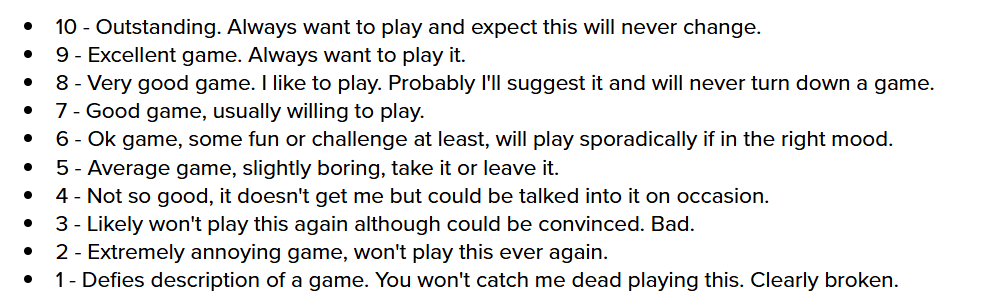
    Boardgamegeek.com gives the following guidance for their rating system:

    10 - Outstanding. Always want to play and expect this will never change. 9 - Excellent game. Always want to play it. 8 - Very good game. I like to play. Probably I'll suggest it and will never turn down a game. 7 - Good game, usually willing to play. 6 - Ok game, some fun or challenge at least, will play sporadically if in the right mood. 5 - Average game, slightly boring, take it or leave it. 4 - Not so good, it doesn't get me but could be talked into it on occasion. 3 - Likely won't play this again although could be convinced. Bad. 2 - Extremely annoying game, won't play this ever again. 1 - Defies description of a game. You won't catch me dead playing this. Clearly broken.

    Given that system, I don’t think I’ve ever played a 10. I’m not sure I could even call something a 9 on this scale. “Always want to play” is hard – there are thousands of games. I would be willing to play most of them, but moods change.

    Of the games I own, the “best” ones top out at 8. I like them. I’ll suggest them or ask if I should bring them, or if people ask me to bring them, I will do so. I would put John Company: Second Edition at 8, but it’s heavy. The weight isn’t for most crowds, and the subject matter definitely isn’t, either. More accessibly, I might call Kutna Hora an 8. That’s more likely to make it to the table because it’s lighter, and also, everyone I’ve played it with has liked it, too.

    7 and 6 are “most” games. Obviously not the actual majority of games, but of the “hobbyist” board games I’ve played and play regularly, “I would play this again” is usually my reaction. (I frequently don’t actually play again, though, because in a friend group that collectively owns thousands of games and continually acquires new ones, there’s always something I’ve never seen before that turns up.) All the classics are probably here; Catan, Carcassone, Power Grid, etc.

    Some fall to 5. In my personal ratings on BGG, things like Codaand Hex Hex are 5s. (Interestingly enough, the site-wide ratings for both are closer to 6.)

    Below that, games become “bad”. But take a look at the descriptions. 4 is “not good … but could be talked into it on occasion.” Now, I can be talked into a lot of games. I’d put the bad party games here, like Cards Against Humanity. I’d probably also put Munchkin (generally regarded as a very bad game) here, too. I’ll almost never “want” to play it, but if the right people ask (or I’m drunk enough), sure.

    3 is “likely won’t play” but “could be convinced” and then closed with just “Bad.” Given that descriptor, I’d probably put Monopoly here (assuming we’re playing rules as written, so it eventually does end). Everyone hates Monopoly. It’s bad. F-tier. But it still rates a 3 out of 10. (That’s not to say a 3 out of 10 is remotely good.)

    In my life, I have played exactly one game that I would actually say was “completely annoying” and that I “won’t play this ever again”. In fact, I like to tell people about it, because I had significantly higher expectations for it. It’s Firefly: the Game. We played it less than once. (We didn’t finish it.) And on BGG, the current site-wide rating is… SEVEN POINT FOUR?! The average gamer is usually willing to play this? I will just about always suggest against it. Often when it’s not even brought up.

    Anyway, rather than get into specific games, my main point is that, on that scale, where 10 is the platonic ideal of a game; one you always want to play and don’t think that will ever change (meaning you’ll never supersede it with newer, which is hard when dozens, if not hundreds of new games come out yearly), “good” goes down to 7, and “yeah, I guess I would play this sometimes” goes down to THREE.

    So yeah, there are too many games. A few are great. Many are good. Some are bad. They’re all fine.

  • Booking hotels for Gen Con is fine.

    Every year around this time, the Gen Con housing portal opens up. Some years ago, they changed the system so that instead of just first-come first-served at Noon on Sunday, every badgeholder is assigned a time somewhere between Noon and whenever all the times are done. The “best” rooms are still gone by 1, and the rest generally not much later than that, but that’s what happens at a convention of 70,000 attendees.

    I’ve been attending Gen Con since 2012, and while I’ve had several hotel rooms that were farther than I’d have liked, or booked under unusual arrangements, but I’ve always had one. It’s always possible to stay somewhere, and usually relatively close by. This year is no exception.

    Actually, this year I got what I generally consider my favorite hotel, where all my con friends hang out. The room will be a little cramped, but should be fine for crashing at night.

    Now, just to wait the 5 months until the con.